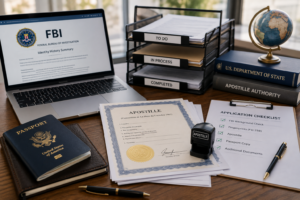
Most people who are preparing international documents for studying abroad, doing business, working, immigration, or a visa application are told they “need an apostille.” However, they are not told which one. So, confusion arises when it comes to understanding the basic difference between a state and federal apostille. This confusion leads to incorrect document submissions, resulting in delays or rejection.
State and Federal are two distinct types of apostilles that include different documents and authorities. Making a wrong choice often leads to loss of processing time, rejections, and having to start over the process.
For first-time applicants, the real challenge begins when handling official documents, including background verification paperwork. So, this is where they choose to use FBI background check apostille services to make the whole process simple to avoid delays, rejections, or unwanted back-and-forth with the authorities.
What Is a Federal Apostille?
A federal apostille is a certificate of authentication issued directly by the Office of Authentication of the U.S. Department of State. This certificate authenticates the documents from federal agencies as legitimate to be accepted in countries under the 1961 Hague Convention.
A federal apostille is only issued by the Office of Authentications. State offices or other entities cannot process such documents. To receive one, you have to submit the original or certified document with FORM DS-4194, along with a small fee made to the Department of State in Washington, D.C.
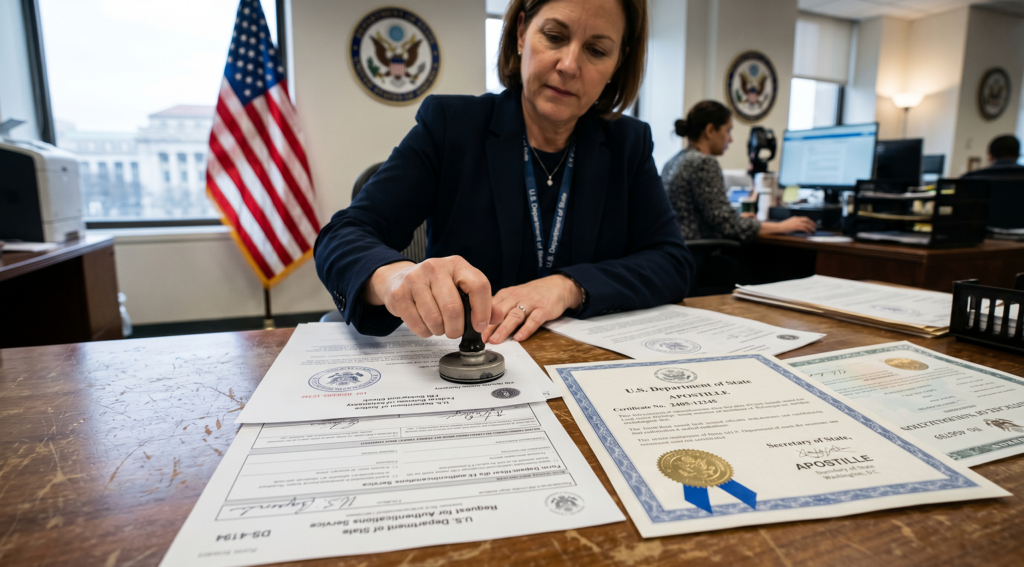
Common documents that will require a federal apostille are:
- FBI background checks
- Certificates of naturalization
- Documents issued by federal agencies (FDA, IRS, etc.)
- Consular reports of birth abroad
Example:
FBI clearance certifications need a federal apostille. They cannot be processed by state authorities.
Important: Federal apostilles are issued for documents that originate from the U.S. federal agencies. If your document was issued by a state, country, or municipal office, you will need a state apostille. The Department of State will reject state-level documents that are submitted for official apostille processing. So this is something applicants should understand to avoid FBI apostille delays or rejections.
What Is a State Apostille?
A state apostille is an official certificate of authentication issued by the Secretary of State or equivalent official in a state where the document was issued or notarized. There are designated offices in every U.S. State and territory that will handle apostille requests for documents originating under its jurisdiction.
Common documents that require a state apostille are:
- Birth certificates
- Marriage certificates
- Death certificates
- Educational diplomas and transcripts
- Notarized documents (like affidavits or power of attorney)
Example:
If you got your birth certificate issued in the state of California, you should get an apostille done by the California Secretary of State and no other.
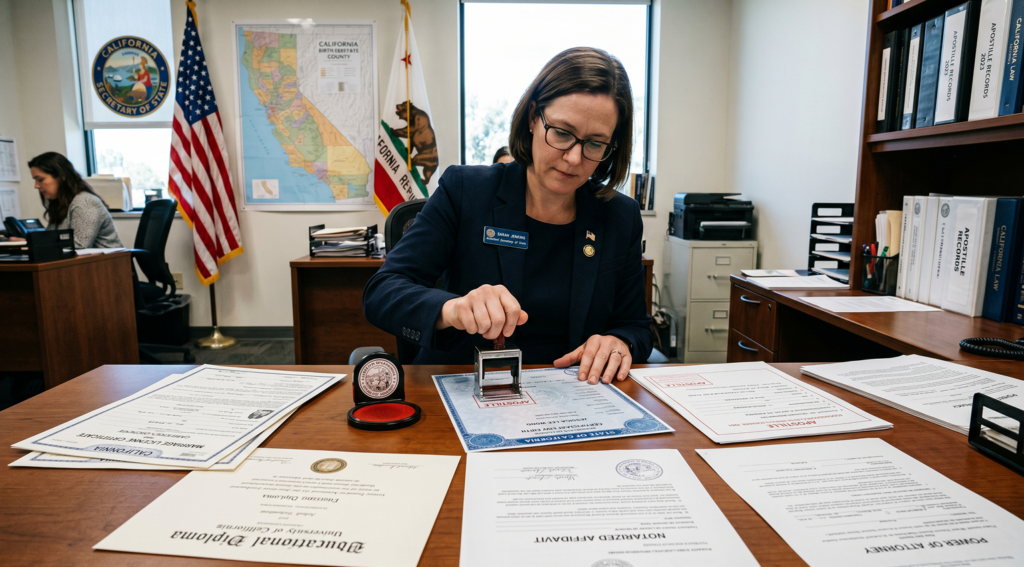
State apostilles generally apply to most document types. It includes birth and marriage certificates, court papers, educational records, notarized documents, and business filings. While most personal documents come under state-level records, state apostilles are often requested more than federal apostilles.
Federal Apostille vs State Apostille: Comparison At A Glance
| Feature | Federal Apostille | State Apostille |
| Issuing Authority | U.S. Department of State, Washington DC | State’s Secretary of State |
| Document Origin | U.S. federal agencies, federal courts | State/local agencies, notaries, state universities |
| Examples | FBI background check, USDA certificate | Birth certificate, marriage certificate, notarized POA |
| Processing Location | Washington, DC | State capital |
| Processing Time | A couple of weeks unless expedited | Varies by state; can be 1–2 weeks |
Issuing Authority Differences
The main difference between federal and state apostilles is the issuing authority, and knowing about it can help you avoid costly mistakes.
The U.S. Department of State, Office of Authentications in Washington, DC, is the only issuing authority for federal apostilles. All requests get processed under a single office, generally by mail or in person.
For state apostilles, the Secretary of State or equivalent office is the issuing authority under the document’s state of origin. Each state has its dedicated process, timelines, and fees, with submission options that include mail, in-person, or online.
Processing Differences
The overall timeline and experience are influenced by the way federal and state apostilles are processed. So, let’s understand the processing of each apostille.
Federal Apostille Processing
Federal apostilles typically follow a centralized process that gets handled in Washington, D.C.
- Processed by the U.S. Department of State
- The average timeline is between 4 and 8 weeks.
- Submission is by mail and walk-in primarily.
- Pre-determined cost per document.
- Centralized systems include longer wait times.
State Apostille Processing
State Apostilles are a more flexible choice and are typically handled at the state level.
- Certified by the Secretary of State.
- Timeline includes a few days to a couple of weeks
- Most states have expedited or walk-in services.
- Faster processing is implied by a decentralized system.
Typical Processing Time for FBI Background Check Apostille
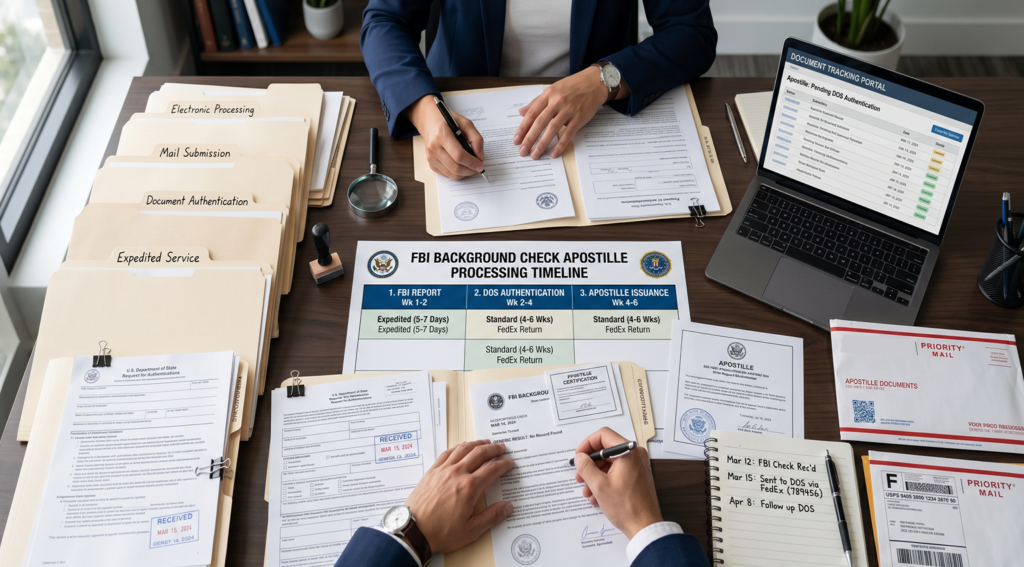
The FBI background check apostille timeline depends on the procedure to request a report, mode of submission, and either standard or expedited processing. The process involves multiple steps, and the timeline varies for each applicant. The turnaround times are expected to be as follows:
- FBI Background Check: 3-7 days ( electronic ) to 2-3 weeks (mail)
- Apostille (U.S. Department of State): 6-8 weeks or longer.
- Shipping (where necessary): multiple days to 2 weeks.
- Rapid (Professional) Services: ~10 business days
When You Need a Federal vs State Apostille
The following are the common scenarios that highlight when each type is required:
Scenarios Requiring a Federal Apostille
One requires an apostille when a document is issued by a U.S. federal authority. The authenticity of such documents is checked at the national level and must be verified by the U.S. Department of State.
They are typically:
- Issued by federal departments or agencies
- Nationally certified.
- Not taken through any governmental agency.
- Centralized processing at Washington, D.C.
By understanding this process, documents are linked to federal institutions. As an example, when you are submitting an application to any particular state, like New Mexico, you need to know that federal documents do not exist at that level. In cases like these, applicants would select professional services offering an FBI apostille in New Mexico that eases the process of document authentication through the relevant routes of national authority.
Scenarios Requiring a State Apostille
Documents that have been created by a state, local authority, or notarization require a state apostille. The documents are usually under state jurisdiction and must be verifiable as such.
They are:
- Published by a state or local government.
- Includes documents that are notarized in a state.
- Filed with the Secretary of State, where the document was prepared.
- Does not get authenticated at the federal level.
Knowing about these differences will enable you to handle state-level documents efficiently, ensuring they get processed through the appropriate authorities from the start.
How Fast FBI Apostille Handle State Apostilles for FBI Background Checks
Understanding whether your document needs a federal or state apostille can be confusing, especially when dealing with FBI background checks. Even when the requirement is clear, applicants often struggle with correct routing, documentation, and submission standards.
Fast FBI Apostille specifically simplifies state apostille processing for FBI background checks, ensuring your documents are handled correctly from the start and submitted without errors or delays.
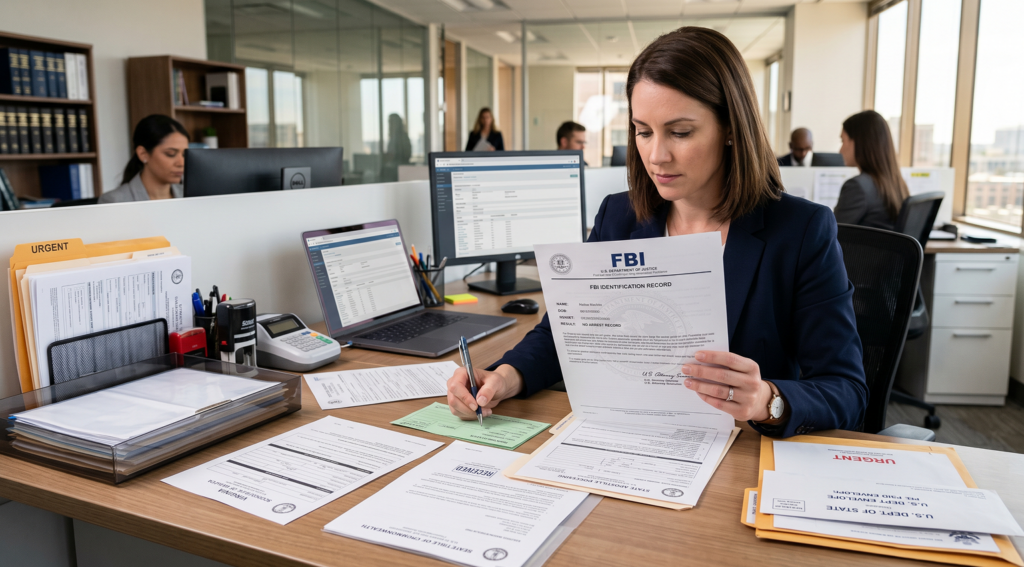
End-to-End State Apostille Handling for FBI Documents
- Secure Document Upload
Upload your official FBI Identity History Summary through a secure system. Each document is checked to ensure it meets state apostille requirements.
- Document Verification & Routing
Your FBI background check is reviewed and prepared for the correct state-level authentication process, avoiding misrouting or rejection.
- Apostille Certification & Tracked Delivery
We handle the complete submission to the appropriate state authority, obtain the apostille certification, and ship the finalized document with tracked delivery.
Typical Processing Timeline
- FBI Background Check issuance: 3–5 business days
- State apostille processing: 1–2 business days (expedited handling & tracked delivery)
- Total turnaround: 24 hours to 10 business days (depending on selected speed and document readiness)
Reducing Errors and Processing Delays
Most delays occur due to incorrect submission, missing document requirements, or confusion between federal and state apostille routes. We ensure FBI background checks are processed through the correct state authority the first time, reducing rejections and resubmissions.
For applicants with tight international deadlines, this streamlined approach helps ensure faster and more reliable document acceptance abroad.
Conclusion
Obtaining an apostille is more than just paperwork. It is concerned with making sure every action is undertaken properly and in good time. To a number of applicants, especially those dealing with federal documents, the process can be time-consuming and confusing when any important fact is overlooked.
Using the services of a professional apostille simplifies the whole process and takes you through the steps necessary with greater precision. Contact us today to ensure that your documents are processed immediately from the beginning!
Frequently Asked Questions
Can an FBI background check apostille be used in all countries?
Countries that are members of the Hague Convention are the only ones that will accept apostilled documents to be verified officially during international verification.
What happens if a document is submitted to the wrong apostille authority?
It is rejected and has to be resubmitted properly, and this causes further waiting as well as processing delays.
Do apostille requirements change depending on the document’s purpose?
Yes, it depends on the rules of the destination country, the type of document, and the purpose of its legal or official use.