Timing matters when you need an apostille on your FBI background check for a visa, job, business, or residency application. The process moves through multiple official stages. Each one is affected by different factors that either keep things on track or push your deadline back by weeks.
This is why most first-time applicants choose a professional FBI background check apostille service to simplify the process. The professionals have a clear idea of the current processing queues, handle every document preparation correctly, and offer different submission options that are simply unavailable when you apply independently.
What Actually Affects How Long It Takes
Let us now walk you through each factor to help you approach the process informed and well-prepared.
The Processing Tier You Choose
The tier selected at submission is the most controllable factor in the timeline for the FBI Background Check Apostille. To understand its impact, the process breaks down as follows:
- FBI Background Check: 1 day to 2 weeks
- Standard Apostille Processing: 4 to 8 weeks
- Expedited (Professional) Services: 10 business days
The whole process takes about 2 to 10 weeks, depending on the processing option you choose.
However, choosing professional services such as Fast FBI Apostille offers structured options that include:
- Standard: 4 weeks
- Expedited: 10 business days
- Rush: 72 hours
- Emergency: 24 hours
Selecting the wrong processing option is a common cause of FBI apostille delays, even if your documents are correct.
The Quality of Your Fingerprints
The FBI will need fingerprints on a standard FD-258 card. If your prints are faint, smeared, or incomplete, then the FBI will reject the card and return it, restarting the entire process.
Common issues with fingerprinting include:
- Ink too light from poor contact or dry rollers
- Smearing from moving the card before the ink sets
- Missing areas in plain or slap impressions
- Rolled prints cut off at the card edges
- Using a non-FD-258 card
Using professional fingerprinting services can reduce most of these risks.
Submitting to the Right Apostille Authority
One of the main mistakes that most applicants make is not understanding the difference between federal and state apostille processing. Overlooking this can lead to rejections and delays. While state offices handle documents such as marriage or birth certificates, an FBI background check should go through the U.S. Department of State, the federal apostille authority.
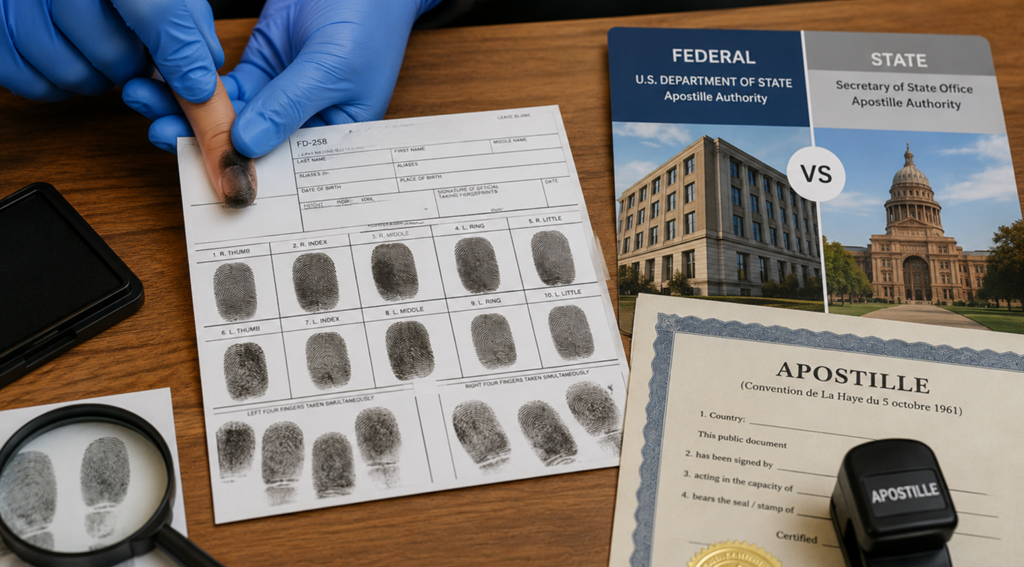
There are a few countries, such as Costa Rica, Spain, and South Korea, that specifically require a federal apostille and will reject state apostilles.
Whether Your Destination Country Accepts Apostilles
The entire apostille system applies only to countries that are members of the Hague Apostille Convention. This is important in FBI apostilles for immigration and work visa applications, since not all destination countries are members.
Non-member countries will need a consular legalization instead, which is more time-consuming.
So, always ensure to confirm the status of your destination country. Requesting an apostille when it won’t be accepted is a waste of time and money.
Current Volume at the FBI and State Department
Both the FBI and the State Department operate at their own pace. So the processing times vary with demand. Delays are more likely during:
- January–March peak visa/immigration season
- After major immigration policy changes
- During federal staffing cuts or hiring freezes
- During shutdowns or public health emergencies
The current estimated processing time is published on the FBI’s official website. Checking this before you submit will give you a realistic baseline and help determine which processing speed makes sense.
Errors in the Submitted Documents
One of the most preventable causes of delay is document errors. They are more likely to occur when the applicant lacks a clear understanding of the process. Main issues include:
- The background check is older than six months
- Unclear PDF or missing FBI seal visibility
- Name mismatch with passport
- Incorrect or missing destination country
One of the easiest ways to protect your timeline is to complete an accurate submission on the first attempt.
Where You Are Based
Every applicant in the United States, regardless of the state, goes through the same official process. Neither the FBI nor the U.S. Department of State fast-tracks submissions based on location. Typically, location affects how long documents spend in transit at both ends of the submission process, adding days to the overall timeline.
This is something applicants in any state should consider when planning their schedule. For instance, those arranging for FBI apostilles in Colorado use the same federal channels as applicants in Texas or California. But if they submit by mail instead of using a service that handles the process digitally, add the time needed to be built into the plan.
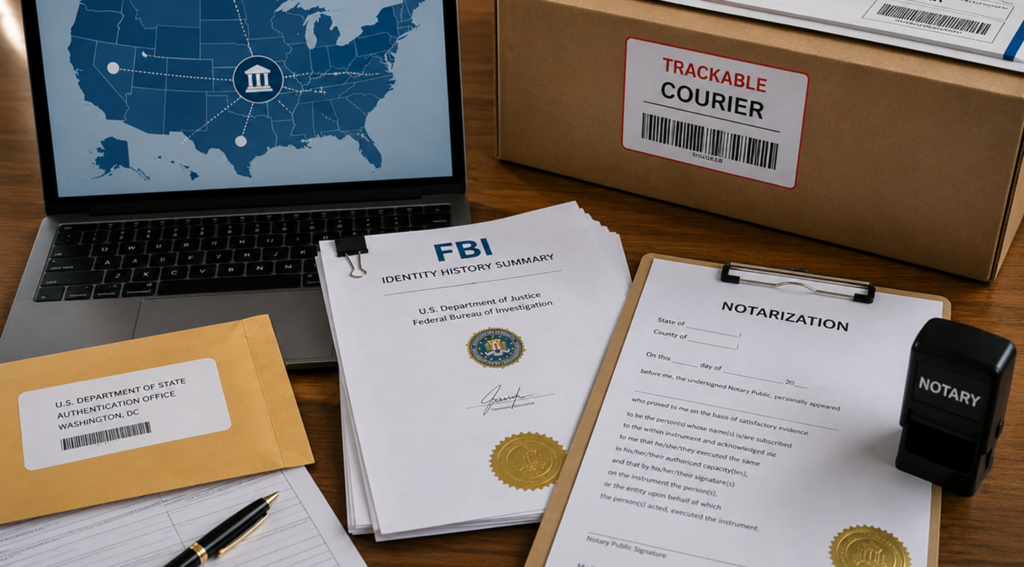
Using a trackable courier service for outbound and return shipments will remove most of the uncertainty that comes with standard mail.
Notarization Requirements for Accompanying Documents
Some applications might require additional documents for a background check, mainly for visas or international jobs. If notarization is required and done incorrectly, the State Department might reject the entire package. Common issues include:
- Expired notary commission
- Incorrect notarization format
- Missing wet signature (photocopies not accepted)
- Submission of a wrong document instead of the FBI Identity History Summary
Always check the State Department’s country-specific requirements before preparing the package to prevent rejection at this stage.
Final Thoughts
Getting an FBI background check apostille doesn’t have to take a long time or be complicated. Most delays come down to preparation gaps and addressing small things before submission. This is where professional apostille services step in to simplify the process.
At Fast FBI Apostille, we handle every step of this process for applicants who want it done right and on time. So, contact us today and let our team take it from here!
Frequently Asked Questions
Does choosing expedited processing guarantee a faster result?
It significantly speeds up the apostille handling, but the FBI’s own processing time is separate and depends on the current CJIS workload. Expedited processing reduces the apostille step, not the background check step.
Can the apostille be skipped if the background check is already issued?
No. The apostille authenticates the FBI’s official signature for use abroad. It is required regardless of when the background check was issued.
How long is the FBI background check apostille document valid?
The U.S. does not set a validity period. Most countries require that the FBI background check be issued within the past three to six months. Always confirm the requirement with the institution or authority that requested the document.